


By Isabel M. Castro
“Art is never silent in times of political upheaval.” — Sarah O’Connell
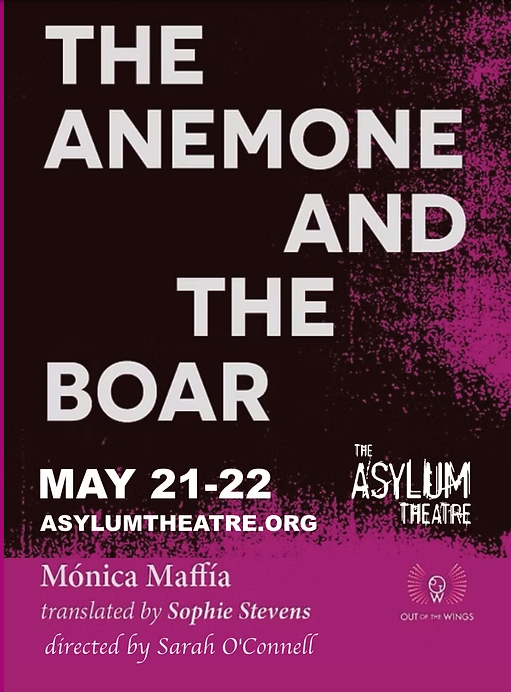
In a cultural moment shaped by urgent conversations surrounding censorship, democracy, and political division, The Anemone and the Boar will be performed in Las Vegas with striking relevance. Presented by The Asylum Theatre, the production marks both the United States premiere of the play and the international launch of Stevens’ English translation. Performances will take place at Positively Arts stage at 7:30 p.m. on Thursday, May 21, and Friday, May 22. Seating is limited for the intimate black box staging, creating an immersive theatrical experience that feels both personal and politically charged. Admission is free and open to the public.


Written by acclaimed Argentine playwright Mónica Maffía and translated into English by Sophie Stevens, the production explores the human cost of authoritarianism through the intimate lives of three women struggling to survive amid the chaos of the Spanish Civil War.
Directed by Sarah O’Connell, the production stars an accomplished trio of performers — Gigi Guizado, Lizette Hunter, and Jackie Hoopz Lakoudis — portraying Paquita, Carmen, and Encarnación, three women who host a weekly radio program dedicated to culture, poetry, and public discourse during one of the most volatile periods in European history.
What begins as a platform for artistic conversation gradually transforms into a battleground of ideology, fear, and survival. As censorship intensifies and fascism creeps into everyday life, the women must confront impossible choices: remain silent, publicly resist, or flee into exile.
Rather than relying on spectacle, The Anemone and the Boar unfolds through poetic dialogue, layered performances, and the atmospheric intimacy of radio storytelling. References to artists and intellectuals of the era — including the legendary poet Federico García Lorca — deepen the play’s emotional resonance while highlighting the devastating impact of political violence on artists and cultural institutions.
Theatre as Resistance
O’Connell approaches the material with a keen awareness of how history echoes into the present. The play’s themes of propaganda, censorship, and social polarization feel especially timely for audiences navigating contemporary political unrest and global instability.
Yet despite its historical setting, the production never loses sight of its characters’ deeply personal experiences. The women at the center of the story are not abstract political symbols; they are artists, workers, friends, and collaborators whose relationships become strained by ideological differences and the pressure of survival.
The play’s structure also reflects Maffía’s multidisciplinary artistic background. Poetry functions almost as a living narrator throughout the production, weaving together international news, cultural commentary, and emotional reflection. The result is a work that feels lyrical while maintaining dramatic urgency.
An Ensemble Rooted in Storytelling
At the center of the production is Gigi Guizado as Paquita. An internationally recognized actor, writer, and director, Guizado brings a classical foundation and multilingual sensibility to the role. As Resident Playwright for The Asylum Theatre and a member of the Out of the Wings Collective, she has become known for championing translated and international works.
Her background makes her particularly suited to Maffía’s layered script. Guizado’s own translation work includes The Therapist by Gabriela Yepes, published through Inti Press, while her poetry has appeared in journals such as The Emerson Review, Rogue Agent Journal, and Salamander Ink Magazine.
In The Anemone and the Boar, Paquita emerges as a woman caught between conviction and fear, intellectualism and survival. Guizado’s performance captures the emotional tension of someone attempting to preserve artistic integrity while living under escalating oppression.
Playing Carmen is Lizette Hunter, a Las Vegas-based performer whose emotional honesty grounds the production. Born in Juárez, Mexico, and raised in Las Vegas, Hunter discovered storytelling through music videos, cinema, and creative writing.
For Hunter, acting has always been rooted in transformation and emotional connection. She gravitates toward intense, emotionally charged roles that challenge both performer and audience.
Her character, Carmen, serves as the sound engineer for the women’s radio program, creating sound effects and maintaining the station’s technical operations while chaos unfolds beyond its walls. Carmen becomes an especially compelling figure because she exists at the intersection of observation and participation — constantly listening, adapting, and preparing for uncertainty.
Hunter’s admiration for performers such as Robin Williams, Kathy Bates, and Jon Bernthal is reflected in her emotionally grounded approach to performance. Audiences may also recognize her from Session, a recent selection at the Nevada Women’s Film Festival.
Jackie Hoopz Lakoudis: Finding Meaning Through Representation
Meanwhile, Hoopz Lakoudis brings warmth, vulnerability, and emotional depth to the role of Encarnación. Her journey into theatre began early, sparked by a childhood fascination with creativity and performance.
One of her earliest memories of storytelling dates to elementary school, when she ran for student body president. While classmates covered the school with campaign posters, Hoopz Lakoudis decided to take a different approach. Together with her mother, she created campaign buttons that read: “Don’t be wacky, vote for Jackie.”
“It worked because everyone remembered my name,” she recalls with a laugh.
Years later, she made the bold decision to leave North Carolina and move alone to Los Angeles at age 25 to pursue acting professionally — a leap she jokingly describes as her “quarter-life crisis.”
“I was terrified,” she admits. “I didn’t know anyone, but I also knew I needed to try. I didn’t want fear to stop me from pursuing something I loved.”
Like many working actors, Hoopz Lakoudis built her career gradually through community theatre before moving into commercials, film, and stage productions. The experience taught her resilience, adaptability, and patience — qualities that continue to shape her artistic voice.
“I’ve always loved stories that allow people to escape for a little while,” she says. “But at the same time, the stories that stay with us are often the ones that help us see ourselves — or see someone else — differently.”
For her, representation in theatre is not simply about visibility. It fundamentally changes how stories are experienced and understood.
That perspective informs every role she takes on. Hoopz Lakoudis values emotional honesty above all else, striving to fully immerse herself in a character’s inner life. Outside of acting, creativity continues to shape nearly every aspect of her life, from painting and jewelry-making to character development and storytelling.
The Voice Behind the Play
While the production’s emotional immediacy belongs to its performers, the play itself reflects the artistic depth of playwright Mónica Maffía. A respected Argentine scholar, musician, and theatre artist, Maffía studied at London’s Royal Academy of Dramatic Art and Middlesex University before earning a Doctorate in Literature from the University of El Salvador. Her work often blends poetry, music, political history, and theatrical experimentation, giving The Anemone and the Boar its lyrical structure and emotional complexity.
A Timely Production for Las Vegas Audiences
In recent years, Las Vegas has continued to expand its reputation as a city capable of producing ambitious and internationally minded theatre. Productions like The Anemone and the Boar demonstrate how local companies are increasingly embracing socially conscious storytelling and global perspectives.
The Asylum Theatre’s commitment to presenting translated works and underrepresented voices adds an important dimension to the region’s evolving arts landscape. By staging Maffía’s play in an intimate black box setting, the company invites audiences to engage with questions that remain painfully relevant today: How do artists survive under authoritarian systems? What responsibilities do creatives have during political unrest? Can storytelling itself become an act of resistance?
Those questions linger long after the final scene.
The Asylum Theatre
The Asylum Theatre is celebrating the launch of its 30th Anniversary season with the support of women leaders in the arts who opened their doors to bring this international collaboration to Southern Nevada including Pilita Simpson (Positively Arts), Heather Addison (UNLV School of Cinematic Arts, Women in Film NV), Leah Devora (Art Therapy Café), Alisha Kerlin (UNLV Marjorie Barrick Museum of Art), and Catherine Boyle (Out of the Wings Collective at Kings College, London).
The Asylum was founded in 1996 to develop new ideas and support emerging artists, connecting audiences to new work and artists with one another. We are a haven in Southern Nevada for partners, both nationally and internationally, providing the public access to tools which empower us to create, heal, and communicate.
For Las Vegas theatre lovers, artists, students, and anyone interested in politically engaged performance, The Anemone and the Boar promises an evening of emotionally resonant and intellectually compelling theatre.

Performances take place Thursday, May 21, and Friday, May 22, 2026, at 7:30 p.m. at Positively Arts, 4465 West Sunset Road. Admission is free, although seating is limited. Click here for tickets. A public, hybrid in-person and virtual international book launch event will be held with light refreshments at 10 a.m. on Friday, May 22, at the UNLV Marjorie Barrick Museum of Art, 4505 S. Maryland Parkway.
For more information, visit asylumtheatre.org, follow Facebook @AsylumTheatreLasVegas, Instagram @theasylumvegas, and YouTube @The Asylum Theatre.